
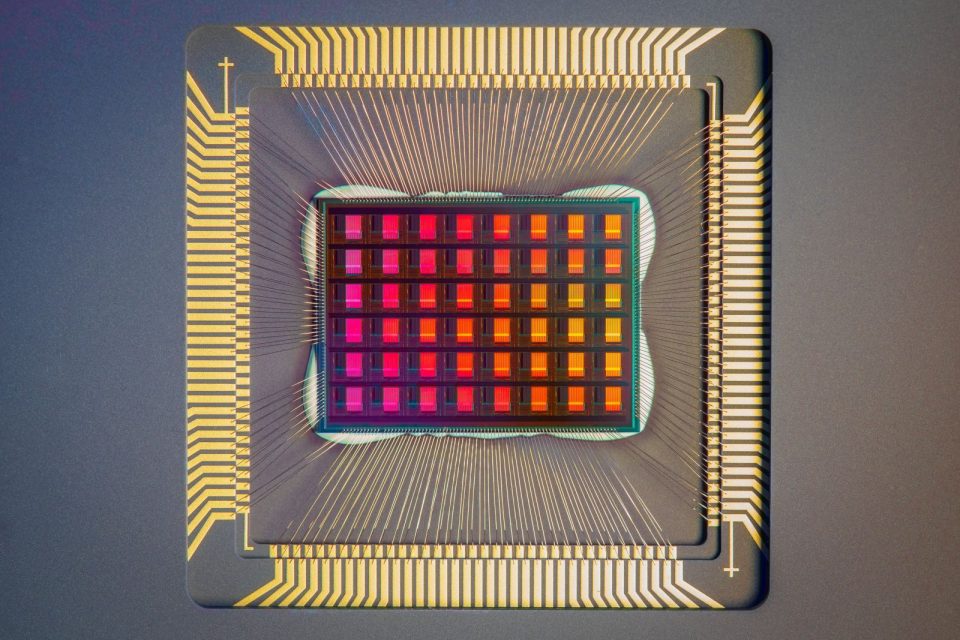
Modern AI chips have dramatically accelerated machine learning, but they still fall short of the brain’s efficiency. Neuromorphic computing aims to close that gap by mimicking how biological neurons process information. Instead of brute-force computation, these systems prioritize adaptability, parallelism, and ultra-low power consumption.
As AI workloads become more complex and energy-intensive, neuromorphic computing is gaining attention as a long-term solution for scalable, intelligent systems.
What Is Neuromorphic Computing?
Neuromorphic computing is a brain-inspired computing paradigm that replicates the structure and behavior of neural networks found in the human brain. Unlike traditional processors that separate memory and computation, neuromorphic chips integrate both, enabling faster and more efficient data processing.
These systems rely on spiking neural networks (SNNs), where information is transmitted via electrical spikes, closely resembling how neurons communicate biologically.
How Neuromorphic Chips Differ from AI Chips
While GPUs, TPUs, and NPUs dominate today’s AI landscape, neuromorphic processors operate on fundamentally different principles.
Key Differences
-
Event-driven processing instead of continuous computation
-
Massive parallelism with thousands to millions of artificial neurons
-
Memory and computation co-located on the same hardware
-
Adaptive learning without constant retraining
Traditional AI chips excel at large-scale training, whereas neuromorphic chips shine in real-time, low-power inference scenarios.
Why Neuromorphic Computing Matters Now
The exponential growth of AI models has exposed critical limitations in existing hardware. Neuromorphic computing addresses these challenges by offering:
-
Energy efficiency comparable to biological brains
-
Low latency for real-time decision-making
-
Scalability for edge and embedded systems
-
Continuous learning without cloud dependency
These benefits make neuromorphic systems especially valuable where power, speed, and autonomy are critical.
Real-World Applications of Neuromorphic Computing
Although still emerging, neuromorphic computing is already finding practical use cases across industries.
Edge AI and IoT Devices
Neuromorphic chips enable always-on intelligence in sensors, cameras, and wearables without draining batteries. This is ideal for smart cities, healthcare monitoring, and industrial automation.
Robotics and Autonomous Systems
Robots powered by neuromorphic hardware can adapt to unpredictable environments in real time, improving navigation, grasping, and human interaction.
Vision and Speech Processing
Spiking neural networks are particularly efficient at pattern recognition, making them suitable for visual perception, speech recognition, and auditory sensing.
Brain–Computer Interfaces
Neuromorphic systems align naturally with neural signals, supporting advances in prosthetics, neurorehabilitation, and cognitive research.
Leading Neuromorphic Computing Projects
Several organizations are actively developing neuromorphic technologies.
-
IBM TrueNorth focuses on ultra-low-power neural inference
-
Intel Loihi emphasizes on-chip learning and adaptability
-
BrainScaleS explores accelerated brain-like simulations
-
SpiNNaker supports large-scale neural network modeling
These platforms demonstrate the growing momentum behind neuromorphic research.
Challenges Slowing Widespread Adoption
Despite its promise, neuromorphic computing faces notable obstacles.
-
Limited software ecosystems compared to AI frameworks
-
Complex programming models unfamiliar to most developers
-
Lack of standardization across hardware platforms
-
Early-stage commercialization with niche deployments
Bridging the gap between neuroscience and computer engineering remains a significant challenge.
The Future of Neuromorphic Computing
Neuromorphic computing is not designed to replace AI chips overnight. Instead, it is expected to complement existing architectures, particularly in edge and real-time environments.
As tools, standards, and developer expertise mature, neuromorphic processors may become foundational to next-generation artificial intelligence, enabling machines that learn continuously, consume minimal power, and interact naturally with the world.
Frequently Asked Questions (FAQs)
What makes neuromorphic computing different from traditional AI?
Neuromorphic computing uses brain-inspired architectures and spiking neurons, while traditional AI relies on mathematical operations optimized for GPUs and accelerators.
Is neuromorphic computing suitable for cloud data centers?
It is better suited for edge and embedded systems rather than large-scale cloud training environments.
Do neuromorphic chips support machine learning?
Yes, but they use spiking neural networks, which differ from conventional deep learning models.
Can neuromorphic systems learn in real time?
Yes, many neuromorphic chips support on-chip, continuous learning without retraining from scratch.
Are neuromorphic computers commercially available?
Some experimental and limited commercial systems exist, but widespread adoption is still developing.
Will neuromorphic computing replace GPUs?
No, it is more likely to complement GPUs by handling specific workloads efficiently.
Which industries will benefit most from neuromorphic computing?
Robotics, healthcare, IoT, autonomous systems, and neuroscience-driven applications stand to gain the most.
