
Gone are the days when an orchard required acres of rolling countryside or a large Victorian walled garden to sustain it. Today, the average enthusiastic grower is more likely to be working with a suburban back garden, an allotment patch, or even a modest patio. This reduction in space has not dampened the nation’s appetite for home-grown produce; if anything, the desire to bite into a sun-warmed apple picked seconds ago is stronger than ever. This unique set of pressures—high demand for produce but limited space—has ushered in the age of the dwarf rootstock.
Despite their surging popularity, misconceptions about these compact powerhouses persist. Many traditionalists view them with suspicion, regarding them as unnatural or merely decorative novelties that lack the grit and productivity of their larger cousins. Others worry about their longevity or assume that a smaller tree must inevitably equate to a smaller harvest. These assumptions often lead gardeners to overlook what could be the most efficient solution for their green spaces. By understanding the physiology and practical benefits of modern rootstocks, we can dismantle these myths and appreciate why the modern miniature tree is a triumph of horticultural science, not a compromise.
A specialist at ChrisBowers notes: “There is a prevailing belief that to grow serious fruit, one needs a serious amount of space. This could not be further from the truth. The introduction of dwarfing rootstocks has democratised fruit growing, allowing high-quality production in areas previously deemed unsuitable. We often see customers hesitate, fearing that a tree kept to two metres cannot possibly support the weight of a heavy crop or survive a British winter. However, when managed correctly, dwarf fruit trees offer a level of control and efficiency that standard trees simply cannot match. From easier harvesting without ladders to the ability to plant multiple varieties in a single bed, these trees are the backbone of the modern, intensive orchard. Whether you are looking for fruit trees for sale for a large pot or a high-density border, the key lies in selecting the correct rootstock for your specific soil conditions.”
Myth 1: Dwarf Trees Produce “Toy” Fruit
Perhaps the most pervasive and illogical myth surrounding dwarf trees is the idea that the physical stature of the tree correlates directly with the size of the fruit it bears. It is easy to see why this assumption takes root; in the natural world, we often associate scale with output. However, this misunderstanding ignores the fundamental mechanics of grafting, which is the standard method for propagating almost all fruit trees for sale in the UK today.
When you purchase a fruit tree, you are buying two distinct organisms fused together: the scion (the top part, which determines the variety) and the rootstock (the bottom part, which determines the size and vigour). If you graft a piece of ‘Bramley’s Seedling’—an apple famous for its massive cooking fruits—onto a dwarfing M27 rootstock, the genetic instructions for fruit development remain entirely with the Bramley scion. The rootstock acts merely as a regulator of water and nutrient uptake, slowing the vegetative growth of the wood but having absolutely no genetic influence on the dimensions of the apple itself.
In fact, the reality is often the opposite of the myth. Because a dwarf tree expends less energy on creating vast amounts of structural timber—thick trunks and spreading branches—it can direct a higher percentage of its carbohydrates into fruit production. This physiological shift often results in fruit that is not only full-sized but occasionally larger and of higher quality than that found on vigorous, unpruned orchard giants. The open habit of a small tree allows sunlight to penetrate right to the centre of the canopy, ensuring that every apple or pear ripens fully and develops its characteristic sugars and colours, unlike the fruit hidden in the shady depths of a large, standard tree.
Myth 2: They Are Weak and Short-Lived
There is a kernel of truth here that has been exaggerated into a falsehood. It is true that a tree on a dwarfing rootstock like M9 or M27 will not live for the century or more that a traditional standard tree on seedling roots might. However, describing them as “short-lived” in a gardening context is misleading. A well-cared-for dwarf apple tree can easily remain productive for 20 to 25 years, and semi-dwarfing varieties like M26 can last even longer. In the context of a home garden, where landscaping trends and personal tastes change, a quarter of a century is a significant and acceptable lifespan.
The perception of weakness often stems from their root anchorage. It is scientifically accurate to say that dwarfing rootstocks produce a smaller, more brittle root system. This is the mechanism by which they keep the tree small; they restrict the flow of vigour. Consequently, these trees almost always require permanent staking. A gardener who plants a dwarf tree and treats it like a vigorous oak—removing the support after a year—will likely find their tree leaning or toppled after a winter gale. This is not a sign of a “weak” plant, but rather a plant with specific engineering requirements.
Furthermore, the “weakness” regarding disease is often misunderstood. While the rootstock itself may have specific susceptibilities (for example, MM106 can be prone to collar rot in very wet soils), the reduced canopy size actually promotes health. The improved air circulation around a smaller tree dries out wet leaves faster, reducing the incidence of fungal issues like scab and mildew. Far from being delicate invalids, dwarf trees are often more hygienic and easier to keep disease-free than their larger counterparts because every leaf and branch is within easy reach for inspection and treatment.
Myth 3: You Can Only Grow Them in Pots
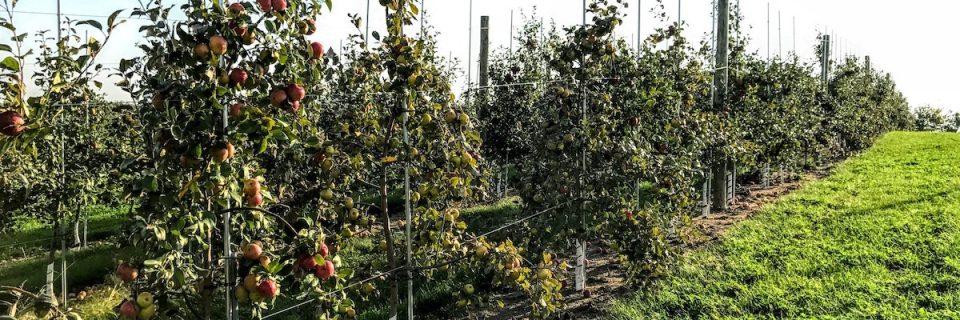
While it is true that dwarf rootstocks are the only viable option for long-term container growing, pigeonholing them as purely “patio plants” is a waste of their potential. In the commercial sector, the vast majority of modern apple orchards are planted with dwarf trees directly into the ground, often spaced less than a metre apart. This “high-density planting” is not done to save money on pots, but to maximise the yield per acre.
Planting dwarf trees in the open ground actually unlocks their full potential. In a pot, a tree is entirely reliant on the gardener for water and nutrients. The moment you miss a watering in August, the fruit quality suffers. In the ground, even a dwarf root system can seek out natural moisture reserves and establish a symbiotic relationship with the soil microbiome. The result is a tree that is far more resilient to drought and stress than its container-bound sibling.
For the home gardener, this means you can create a “min-orchard” in a border that would previously have held only shrubs. You can plant a row of cordons (single-stemmed trees) along a fence line, spaced just 60-80cm apart. This approach allows a gardener with a small strip of earth to grow five or six different varieties of apples—eating, cooking, early, and late season—in a space where a traditional M25 rootstock would support only one vast tree. When you browse fruit trees for sale, do not limit your thinking to the patio; these rootstocks are perfectly capable of thriving in the garden soil, provided the ground is cleared of weeds and grass that might compete with their compact root systems.
Myth 4: They Yield Disappointing Crops
The visual of a small, slender tree naturally leads to the assumption of a meagre harvest. How many apples can a tree the size of a person possibly hold? The answer is often surprising. While a single dwarf tree obviously cannot match the total volume (tonnage) of a fully mature, 30-foot orchard tree, the yield efficiency is vastly superior.
Yield efficiency refers to the amount of fruit produced per square metre of canopy area. Dwarf trees are precocious, meaning they start fruiting very early in their life—often in the second year after planting, and sometimes even the first. A traditional standard tree may take five to seven years to produce a meaningful crop. By the time the large tree has produced its first bushel, the dwarf tree has been feeding the family for half a decade.
Moreover, the “manageable yield” of a dwarf tree is often a blessing in disguise for the average household. A large, mature apple tree can produce hundreds of kilos of fruit in a good year—far more than a typical family can eat, store, or give away. Much of this fruit ends up rotting on the ground or high in the branches where it cannot be reached. In contrast, a dwarf tree might produce 40 to 60 high-quality apples. This is a quantity that is easily consumed and processed. If you want more fruit, the solution is not to plant a bigger tree, but to plant more dwarf trees of different varieties. This staggers the harvest over months rather than arriving in one overwhelming glut.
Myth 5: They Require Specialist Pruning Skills
Pruning is the task that frightens British gardeners more than any other. The complex diagrams of open-centre bushes and delayed open-centre leaders found in old textbooks can be intimidating. A common myth is that because dwarf trees are used in “advanced” commercial orchards, they must require advanced technical skills to maintain.
The reality is that dwarf trees are significantly easier to prune than vigorous ones. The primary reason is accessibility. With a tree on M9 or M26 rootstock, you can prune the entire specimen while standing safely on the ground. There is no need for ladders, pole saws, or risking life and limb to reach the top canopy. This accessibility means you are more likely to actually do the pruning, rather than putting it off because it’s a hassle.
Furthermore, the physiology of dwarf trees works in your favour. Vigorous trees have a strong hormonal drive to grow upwards. When you cut them back, they often react by sending up an explosion of vertical “water shoots,” which clutter the tree and produce no fruit. Dwarf trees have a calmer hormonal balance; they are naturally more inclined to produce fruit buds rather than vegetative timber. When you make a cut on a dwarf tree, it is less likely to fight back with wild growth. The pruning process becomes a gentle shaping exercise rather than a battle against nature. For those looking at fruit trees for sale with trepidation about maintenance, a dwarf tree is undoubtedly the beginner-friendly choice.
Myth 6: All Dwarf Rootstocks Are the Same
To the uninitiated, the label “dwarf” is a catch-all term. You might see a tree labelled simply as “Patio Apple” or “Mini Fruit Tree” at a general garden centre. This lack of specificity breeds the myth that there is a single “dwarf” standard. In reality, the world of rootstocks is nuanced, and treating an M27 the same as an M26 can lead to disaster.
The UK fruit industry relies on a spectrum of rootstocks, each coded (mostly from the research stations at East Malling and Merton). The M27 is the “extreme dwarf.” It produces a tree rarely exceeding 1.5 metres. It is incredibly precarious, has a tiny root system, and will die if the grass grows over its roots or if it dries out. It is strictly for pots or the most pampered garden spots.
One step up is the M9, the most commercially important rootstock in Europe. It grows to about 2 to 2.5 metres. It still needs staking and good soil, but it is more robust than M27. Then there is the M26, often called a “semi-dwarf.” It can reach 3 metres and, while it needs staking in its early years, it eventually forms a stronger anchor and can cope with average garden soils much better than the M9 or M27.
Believing the myth that “dwarf is dwarf” causes gardeners to plant M27 trees in poor, dry soil where they stunt and fail, or M26 trees in large pots where they struggle for root space. When browsing fruit trees for sale, it is imperative to look past the generic “dwarf” label and identify the specific rootstock code. This code is the blueprint for the tree’s future requirements and performance. A specialist nursery will always provide this information, whereas a general retailer might not.
Conclusion
The shift towards smaller gardens does not have to mean a shift away from productive, joyful gardening. The myths surrounding dwarf rootstocks—that they are weak, short-lived, or produce inferior fruit—are largely hangovers from a time when big trees were the only standard of success. Horticultural science has moved on, refining these rootstocks into sophisticated tools that allow us to grow more fruit with less effort and in less space.
By understanding that a dwarf tree is simply a high-performance machine focused on fruit rather than timber, British gardeners can make informed choices. Whether you are planting a high-density cordon row along a fence or a single specimen in a courtyard planter, the modern dwarf fruit tree is a resilient and generous companion. It asks only for a permanent stake and a weed-free patch of soil; in return, it offers a bounty of full-sized, flavourful fruit that is within arm’s reach of even the youngest family members.
